
Search
Georgetown University Conference Focuses on Details, Stories of Enslaved African Americans
-
 December 18, 2025Archive records contain a treasure trove of resources that provide depth and detail to the experiences of enslaved African Americans. It also sheds truth and light so sins and mistakes of the past can be corrected, and the descendants of the enslaved can heal and move forward with their lives.
Deacon Alfred Adams and Ann Boltin participated in a conference regarding improvement of access to records of enslaved people within the Catholic Church. Deacon Adams is the director of the Office of Black Catholics of the Diocese of Baton Rouge, and Boltin is chancellor and archivist of the diocese.
The Nov. 13-14 conference was cohosted by Georgetown University and the Catholic Religious Organizations Studying Slavery (CROSS). CROSS is a nonprofit organization made up of diocesan leaders and members of religious organizations.
Deacon Adams and Boltin joined diocesan leaders, archivists, researchers, college students, university faculty, and members of the descendant community. They discussed best practices to uncover and analyze historical records, study Catholic cemeteries, and incorporate archival material into the classroom.
Attending the conference were the descendants of the 272 enslaved people sold by Maryland Jesuits in 1838 to plantations in Louisiana to save Georgetown University from financial ruin. Boltin said this made the conference richer and more rewarding.
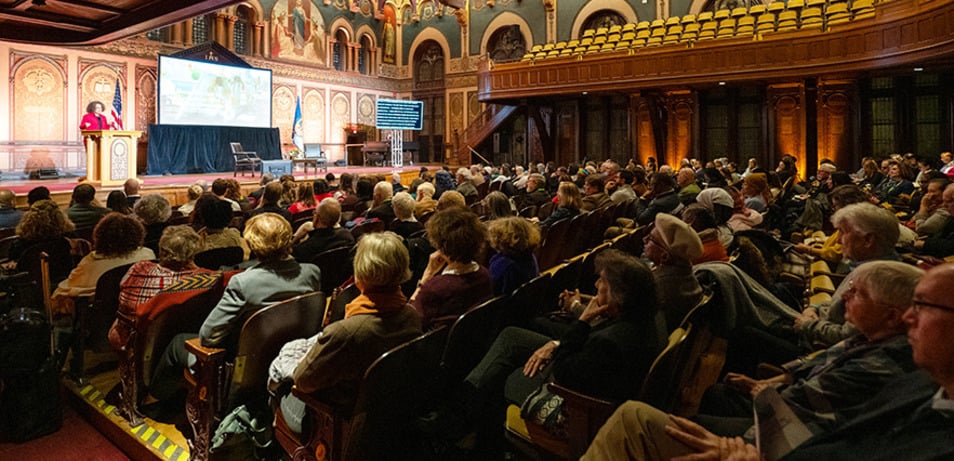
"It changed the dynamic from a mostly academic conference discussing access to records and data to something more meaningful," Boltin said. "It gives purpose to our work to be able to connect with individuals who are seeking information on their ancestors and trying to reconcile their own history and that of the Catholic Church."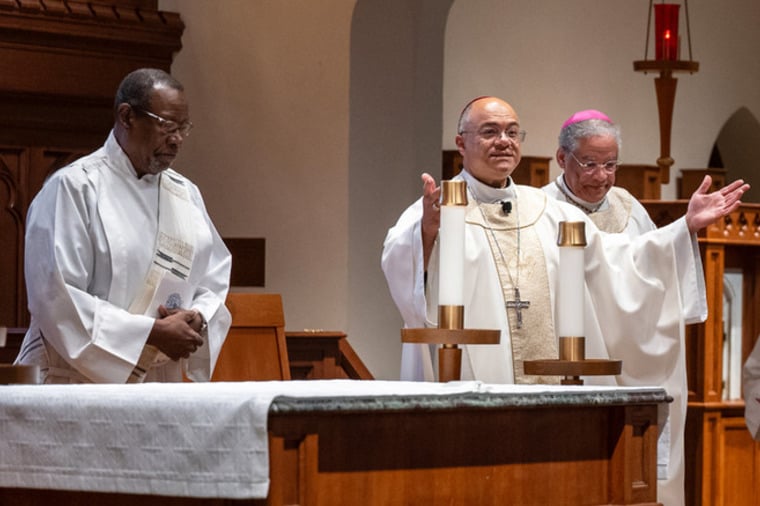 Top right photo: A large group of diocesan leaders, archivists, researchers, Georgetown University faculty and students, and descendants of enslaved African American people attended the CROSS Conference. All photos Courtesy of Georgetown University
Above photo: Archbishop Shelton Fabre of the Diocese of Louisville, Kentucky, a native of New Roads, center, celebrated Mass during the CROSS Conference. Pictured to his left is Deacon Alfred Adams, director of the Office of Black Catholics of the Diocese of Baton Rouge. Pictured to his right is Bishop Joseph N. Perry, auxiliary bishop emeritus of the Archdiocese of Chicago, who has participated in various Black Catholic events in the Diocese of Baton Rouge. Deacon Adams quoted Cross' mission statement: “Recognizing that slavery is a sin, it is (our) mission to promote open and honest access to the historical record in order to achieve a more comprehensive and truthful telling of enslavement within the Catholic Church in the United States.”
"Two years ago, I had the privilege of attending the first CROSS Conference in St. Louis, Missouri," said Deacon Adams. “I was very shocked to hear about the Catholic Church’s leadership participation in slavery, which was a large number of American bishops, priests, and consecrated religious men and women. They owned and sold enslaved people."
Deacon Adams referred to the USCCB Committee on Cultural Diversity letter, "Enduring Call to Love, A Pastoral Letter Against Racism." In the 2018 letter, the bishops acknowledged that the church has failed to live as Christ taught by acts of racism committed by bishops, clergy, religious, laity, and its institutions. It also acknowledged instances in which it had not done enough or stood by silently when grave acts of injustice were committed.
The bishops expressed their deep sorrow and asked for forgiveness from all who have been harmed by these sins committed in the past or in the present.
"As an African American man, deacon and director of the Office of Black Catholics, race is very important to me. Ever since I was an adolescent, I saw that something just was not right in the Church. I could not figure out what it was, but later I realized it was racism, which is evil and a sin. I remember questioning my mother about some of things that I saw in the Catholic Church, and she would only say to me, 'Don’t worry about it, son. God will take care of it.'"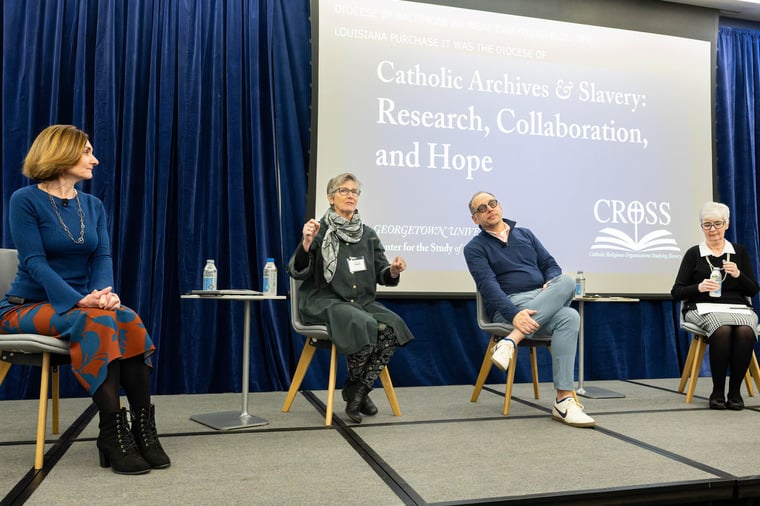 Ann Boltin, left, chancellor and archivist of the Diocese of Baton Rouge, was a moderator at a panel discussion regarding archival collections documenting the enslaved and slavery within the church. Pictured with her are, from left, Emilie Gagnet Leumas, Consultant, EGL Consultants, LLC; Eric Fair, director of archives, Archdiocese of St. Louis; and Tricia Pyne, director, associated archives at St. Mary’s Seminary and University, Baltimore. Though he understood that his mother was trying to build his faith as a Catholic, he questioned God why African Americans were treated different from others.
"CROSS is helping me to recognize that slavery is a sin, and we as Catholics must work together so that we do not repeat what happened in the past. Knowing the truth will indeed set us free."
Boltin noted the collaborative work of the dioceses in the state through the Louisiana Pilot Project, which helps people discover the truth and provides answers to descendants of the enslaved.
"The Louisiana Pilot Project consists of five of our seven dioceses collaborating on many fronts," Boltin said. "We are collecting information on which dioceses have records on the enslaved, how many records there are, what time frame they cover and what types of records they are.
"In addition, we are interested in access to these records, what language they are in and in what formats they are available. For our first look into all of this we are focusing on sacramental records. All dioceses create and maintain these types of records. As we continue to work together, we have found each other to be a great resource and are using this as a springboard to develop relationships and support one another."
Two of Boltin's favorite conference sessions were on cemeteries and education.
"The Archdiocese of D.C. is doing some amazing work on identifying burial sites of the enslaved on old plantations as well as church cemeteries. Gonzaga High School has identified enslaved individuals who were owned by the institution and has turned their discovery into a part of their history classes where students research these men, women, and children and bring their stories to life. It is a very powerful thing.
"You can use archives to tell all kinds of stories and bring the past into the present. I would like to see our program evolve into something like this by bringing history into context and putting a spotlight on real people and events."
Through days of reflection and workshops, Deacon Adams hopes to help people learn more about slavery and the Catholic Church in the United States.
He alluded to the Second Vatican Council's pastoral constitution "Gaudium et Spes" ("Joys and Hopes"). The document calls the church to engage in dialogue with contemporary society and bring Church teaching and moral values to a world torn by hatred, war, and injustice. It states, "The world of today reveals itself as at once powerful and weak, capable of doing what is best or what is worst. There lies before it the way to freedom or slavery, to progress or retreat, to brotherhood or hatred."
"I believe to live the life that Jesus won for us, we must begin to look back at our past mistakes, ask for forgiveness, and hopefully reflect and focus more on the USCCB Pastoral Letter on Racism, “Open Wide Our Hearts: The Enduring Call to Love," Deacon Adams said.